

When I first read about crushes are often just misplaced ambition several years ago, the claim interested me but felt foreign. It framed crushes as a mountain to conquer — a goal in disguise. Coming from a quieter Asian culture around crushes, I couldn't agree. A crush, to me, was never a race. It was a plant you tend in private. Hidden, intimate, slow.
The portrayal of crushes in Asian culture leans on something else: the awakening of a version of yourself that doesn’t yet exist. Not because the feelings are different, but because the ambiguity of expressing them, and reading them, leaves more room for imagination. The classical form of this is K-drama. So little of it is about romantic connection actually happening. It’s about the underdeveloped, unrecognized shape of it. The butterflies flap hardest when nothing is on the table yet. That’s where the space for interpretation lives.
So having a crush isn’t just seeing the world through a new window. It’s a world you get to paint outside that window. Through them, we invent a version of ourselves that doesn’t yet exist. I get to live my creativity, my success, my playfulness, my calmness, my honesty, through someone else, even if only in imagination.
Yet, when that desire gets supplied healthily in the light, that window dissolves.
Recently, my teacher asked us to do a confession circle in front of the whole class. Instead of telling our crushes how we felt, we had to look at them and say, out loud:
“I’m so attracted to your ____, because I so deeply desire my ____.”
The two blanks had to be the same thing.
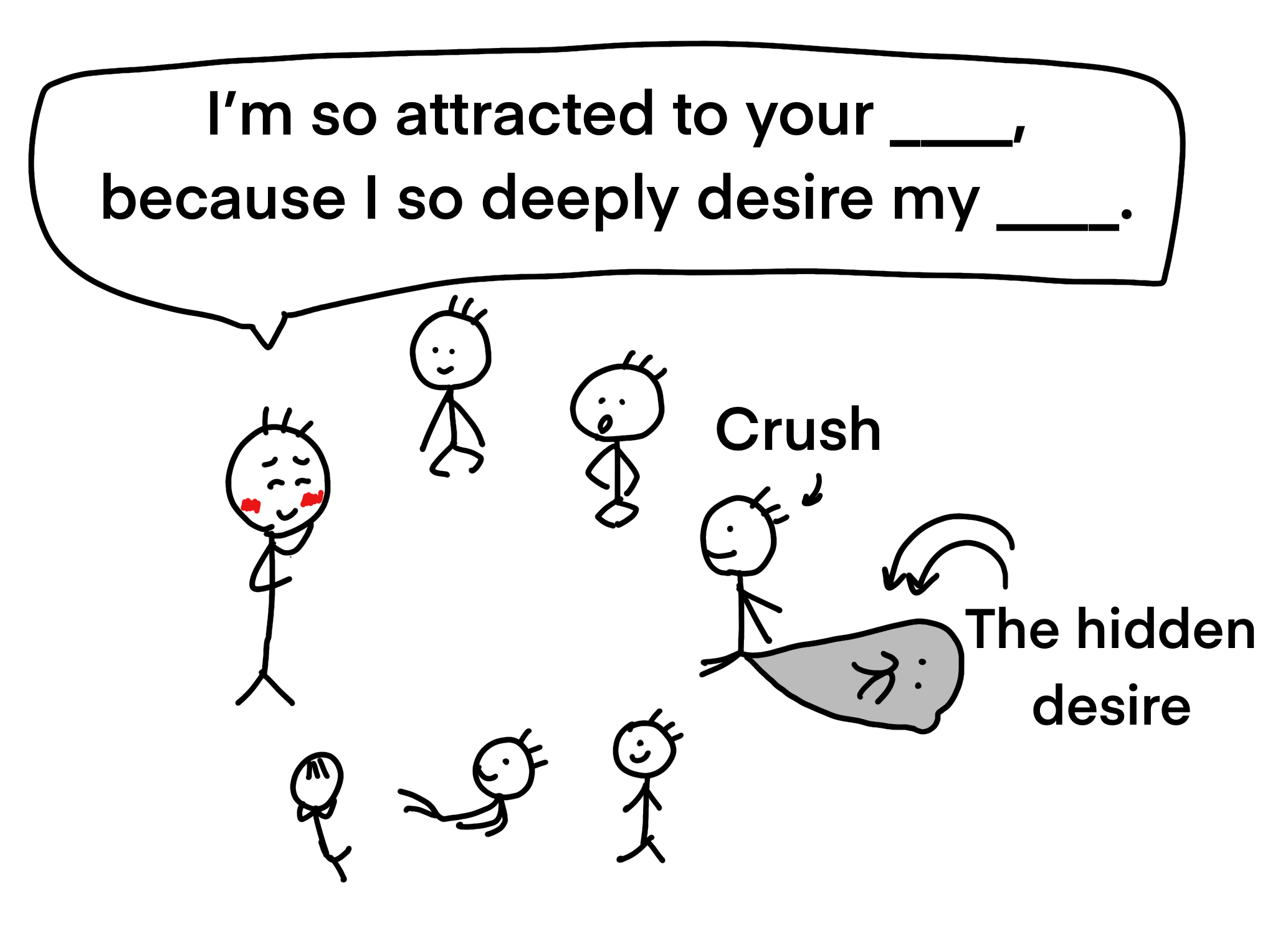
I walked up to a guy I had a big crush on and said: “I’m so attracted to your playful sexuality, because I so deeply desire my playful sexuality.”
What struck me wasn’t just my own confession, it was how naming the desire out loud, in front of everyone, pulled it out of the shadow. The crush had been a hiding place for my desire. Saying it broke the spell.
And then I heard the others. Some admired how much of an asshole someone was, because that was a version of themselves they didn’t feel safe living. That’s when I understood why I sometimes feel pulled, unwillingly, toward people I dislike. They’re carrying a version of me I’d never let myself live.
When we sense something we don’t have, the body collapses all the reasoning into a single concept: attractiveness. We treat it as something to pursue. But few of us notice it’s a reflection, a version of self we don’t yet have the courage to recognize. Maybe it’s a nasty desire to make millions of dollars. To be an attention whore and get validated. To be liberated from being a good person. A crush is a mirror for the true self, sometimes even the suppressed one.
Over the last half year, I’ve had many crushes. Looking back, there’s no pattern in personality, but the storyline is clean. Every crush mapped onto whatever I felt I was missing. When my life felt stagnant, I dated founders, for the risk, the adventure, the success. When I needed calm, I dated meditators. When I felt insecure about my sexiness, I sought out people who lived easily in their sexuality. When I saw how cruelly people treated themselves to succeed, I fell for someone who’d made peace with being a failure.
The intensity of a crush, I’ve found, scales with how distorted my relationship to the desire is. The more deformed, the stronger the pull. After I finished processing my hatred toward sex in a therapy session, my attraction to my sexually liberated crush dropped instantly. If we won’t let ourselves live a version, or don’t believe we can ever become it, we look for redemption in someone else, so we can breathe through the window they embody.
That’s why a crush is a mirror we mistake for a window. It’s not that we don’t know ourselves well enough to see the desire. It’s that the insecurity, the lack of confidence, the quiet disgust at what we want, keeps us from inhabiting it ourselves. The crush points inward, toward what we can’t bear to look at.
So next time, instead of spiraling — they’re not responding, the window is closing — I try to ask a different question:
What’s the reflection this time?