

Growing up in Taiwan, I inherited a body of sexual shame so dense it metastasized into something larger — romantic shame.
The rules I absorbed without knowing I’d absorbed them: I wasn’t allowed to feel sexually attracted to someone before finding admirable qualities in them first. I felt guilty for noticing other people while already in a relationship. My desire was unholy. Sex could only exist as a sacred union. I could be beautiful, even wholesome, but not hot. And a woman couldn’t chase; she waited to be found.
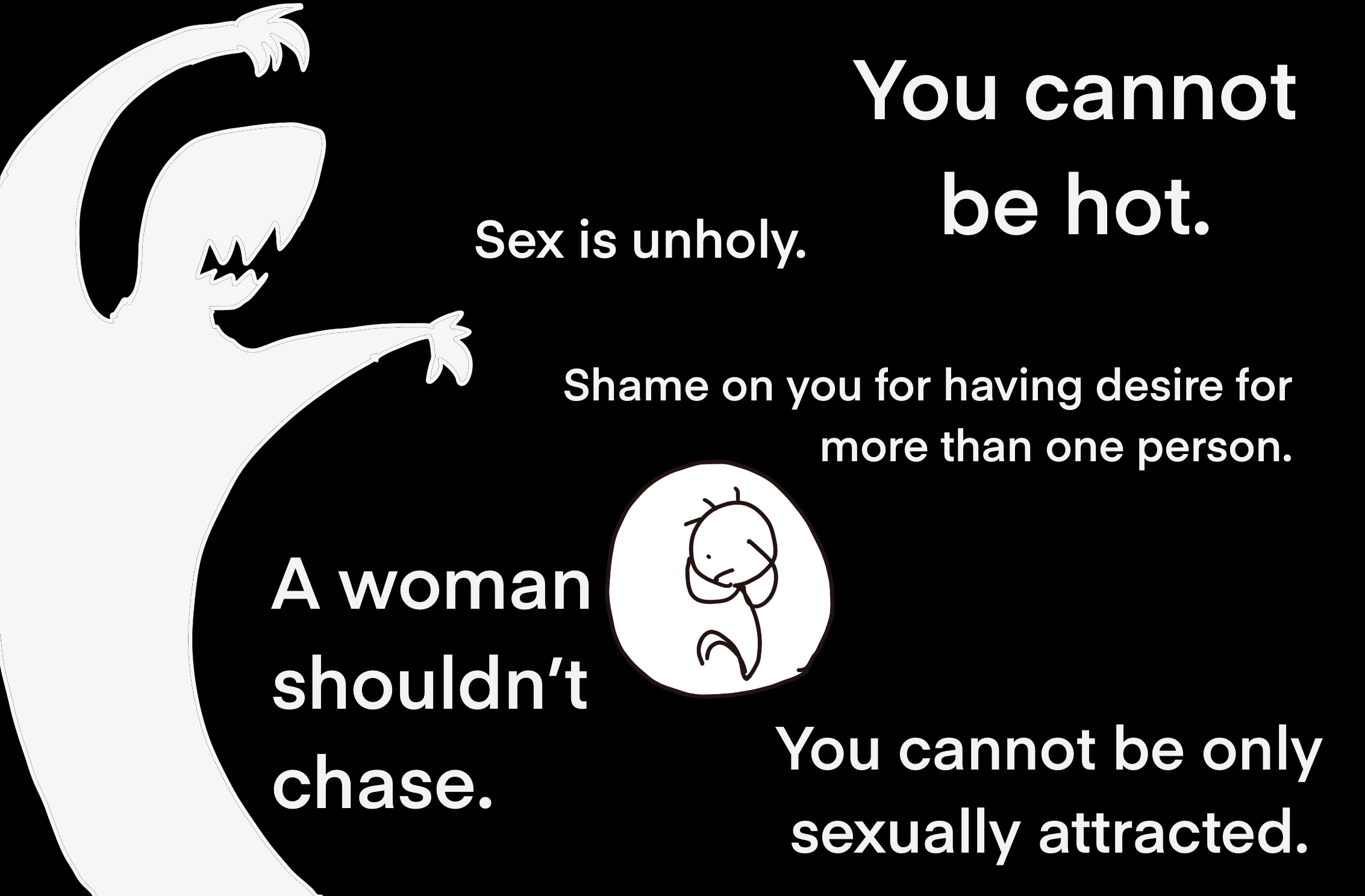
These beliefs made me a romantic conservative. Because desire and romantic interest arrive together, I learned to pathologize anyone who showed interest in me: they have no friends. They’re desperate. I almost never dated.
This year, I started dismantling it. I let myself explore what it felt like to be sexually present in a room. The discovery came quickly: I’m far more magnetic than I’d allowed myself to be. I don’t need an dating app. My emotional sensitivity gives me an accurate read on the energy between people, on the charm I generate without trying.
And yet, even as I reclaimed power in public, something in my body still held the old story when it came to romance. Inferiority, encoded in the muscles.
Last week, a friend set me up on a date calculated as a “perfect astrological match.” What they forgot to mention, until I was already in the car: she was polyamorous.
I’m already in the car.
Worse, the moment I saw her, something in me seized. She looked like every loud, politically aggressive, artistically confrontational white girl I’d navigated around in school. I immediately knew: she’d be opinionated, sharp-edged, and I’d spend the whole night walking on eggshells.
I was so overwhelmed and scared, the date, the noise of Dave and Buster’s, twenty screens, that I left in the middle.
Then something unexpected happened. My friends and the date came after me. We walked. We talked. And I was completely wrong about her. She was kind, genuinely curious, gentle in the way she held the world. Not aggressive at all.
What looked like a disaster was actually a hinge.
For the first time, I felt something loosen in me around who I could connect with, across gender, race, belief, culture. The belief I can only love a very small number of people had been built on shame, not truth.
A sense of ease moved through me. Something healed.
My scarcity didn’t have to govern romance anymore. Like friendship, I’ve never been scared of losing a friend or two, because I’ve always trusted that good people keep arriving. That same faith could live in romance, too.
Afterwards, first time in my life, I finally directly asked someone I’d had a crush for a long time on to go on a date, even though they barely texted me back.
And this time, I started to feel at ease. Their answer wouldn’t define me.
What I received: “My week is a lot. I don’t have the bandwidth to show up as what I’d want to.”
So it was never about me.
Why had I been rejecting myself preemptively, before anyone else had the chance?
I smiled. Because I know now, whoever I meet, however things go, I’ll have a rich life learning from different people. It is already a romantic journey.
Love the conclusion: “So it was never about me.” It never has been personal. Even when we think it is. The more we can trust the world and others instead of thinking it’s out against us, the easier it is to see the beauty.